Internal quality assurance Flanders & Luxembourg
Last update: may 2026
Objective
The primary objective of internal quality assurance is to assess the extent to which operational processes meet their initial objectives, where adjustments may be required, and where improvements are needed. Decreed tasks and the procedures arising from them are given priority attention. Additional projects, supplementary tasks, and internal work processes also fall within the scope of this objective.
Quality Goals
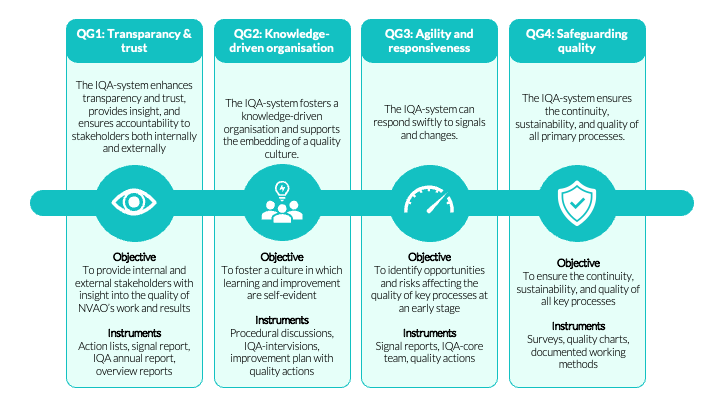
To shape this holistic system of internal quality assurance, a number of quality goals (QGs) have been defined. These goals aim to capture the full scope of the department’s work, with a focus on the primary processes.
PDCA and quality culture
Like quality assurance systems, the NVAO is continuously evolving. From its role within quality assurance frameworks and its activities in assessment procedures, the NVAO also seeks to foster a quality culture both in higher education and within its own organisation.
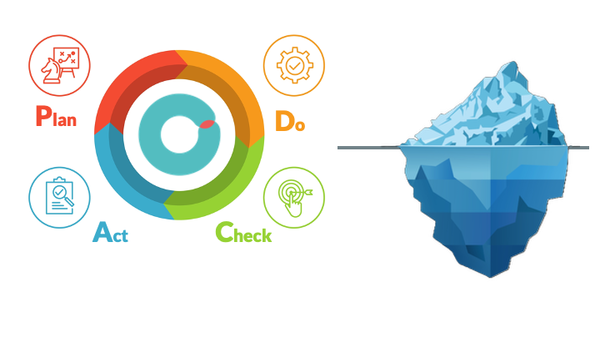
Striving for this quality culture is therefore a natural and integral part of its operations. Rather than following a single annual PDCA cycle, the department has chosen to integrate a continuous PDCA loop into the team’s day-to-day work. In this way, working towards a quality culture becomes a natural component of everyday activities. The continuous PDCA loop also ensures that, in terms of internal quality assurance, there are no longer peak periods in workload. This system has been deliberately embedded as leanly and as integrally as possible within existing work processes. The internal quality assurance system is intended to be supportive and to serve the primary processes, not the other way around. By achieving continuous monitoring and enhancement of quality, the NVAO strengthens its quality culture on a daily basis.
Quality culture and the iceberg
It is not easy to define ‘quality culture’. By definition, culture cannot easily be captured in writing; it is intangible, touches on identity, and is primarily experienced rather than described. NVAO uses the following definition:
“A quality culture is an organisational culture in which all stakeholders naturally strive for continuous quality assurance and enhancement.”
On the one hand, there are formal elements that make a quality culture tangible. These include, among other things, vision, strategy, and information sharing. On the other hand, there are the intangible elements of a quality culture, which are neither tangible nor objectively observable. These relate to a sense of community, proximity within hierarchies, and the safety to raise and discuss issues.
To illustrate this, NVAO uses the metaphor of the iceberg: the formal elements are visible above the water, while the intangible elements lie unseen beneath the surface. The vast majority—and the very foundation—of the iceberg sits below the waterline. This metaphor highlights that visible structures can only function effectively when they are supported by a strong foundation of cultural characteristics that may seem invisible at first glance, but are in fact decisive. The same holds true for most aspects of a quality culture, which consist of psychological elements, values, commitment, engagement, trust, and cultural transmitters such as communication, interaction, and participation in policy.
The elements of a quality culture that are readily observable (above the surface) include the tools and structures used on a daily basis to carry out work. Examples include strategy, policy objectives, rituals and meetings, as well as documents and reports.
The elements that ultimately determine the success of a quality culture are not directly observable and are therefore difficult to capture (below the surface, the undercurrent). This is where team culture, trust, psychological and emotional safety, values and beliefs, identity, unwritten rules, and informal collaboration reside. These invisible values and beliefs determine how the visible instruments actually function.
The PDCA-cycle as a linking methodology
The Plan–Do–Check–Act cycle bridges the gap between the directly visible elements and those that are more difficult to capture. It effectively links the parts of the iceberg that lie below and above the surface.
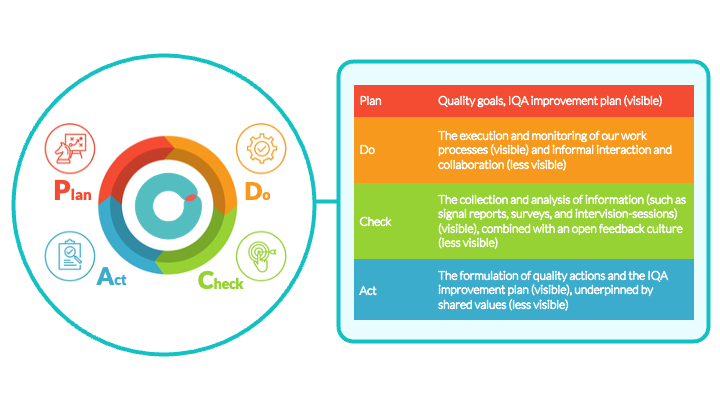
The PDCA cycle only works if both dimensions (visible and invisible, above and below the surface) are in balance.
A Holistic system
The IKZ system of NVAO is a holistic system. The internal quality assurance system is not a collection of separate instruments, but a coherent whole supported across the organisation. It connects objectives, processes, culture, and people, ensuring that quality assurance is both visible and agile, while at the same time supporting the department’s operations without creating additional workload.- Connects instruments: signal reports, reports, action lists, surveys, and intervision sessions do not stand alone, but reinforce one another. A signal may lead to an improvement action, which is subsequently embedded and shared in an intervision session.
- Integrates quality cycle and quality culture: all instruments find their place within a continuous Plan–Do–Check–Act cycle, enabling ongoing learning, improvement, and consolidation.
- Interweaves culture and structure: quality assurance goes beyond procedures and reports. It also concerns behaviours characterised by transparency, dialogue, and shared responsibility, ensuring that quality is embedded in the organisation’s daily operations.
- Transcends team and organisation: the system connects governance, management, staff, and external stakeholders, ensuring that learning and accountability take place collectively. Everyone takes ownership of quality.
- Contributes to our mission: internal quality assurance supports NVAO in promoting trust, transparency, and quality in higher education, without adding an additional bureaucratic layer.

The IQA core team
Internal quality assurance is a shared responsibility for all colleagues within the team. The NVAO expects everyone to take on their role. At the same time, the way in which systems are designed must ensure that the IQA system can respond swiftly and in an agile manner to signals posing a risk to the quality of NVAO’s work. This role is fulfilled by the IQA core team.This team meets weekly to discuss signals received through various channels. In this way, issues related to the quality of NVAO’s processes can be identified quickly, appropriate action can be taken, and follow-up can be ensured.
The IQA core team consists of:
- IQA Coordinator
- Coordinator of the Flemish quality assurance system
- Deputy Director
- Policy Associate
The IQA-toolbox
The instrument set, much like the iceberg metaphor, consists not only of formal and visible elements, but also of rituals and culture that form the underlying current.
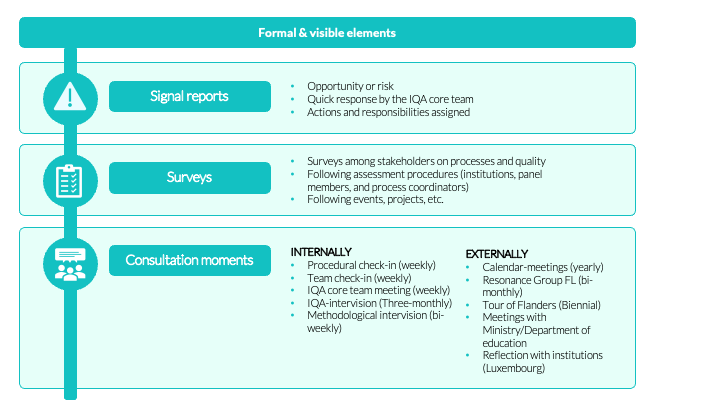
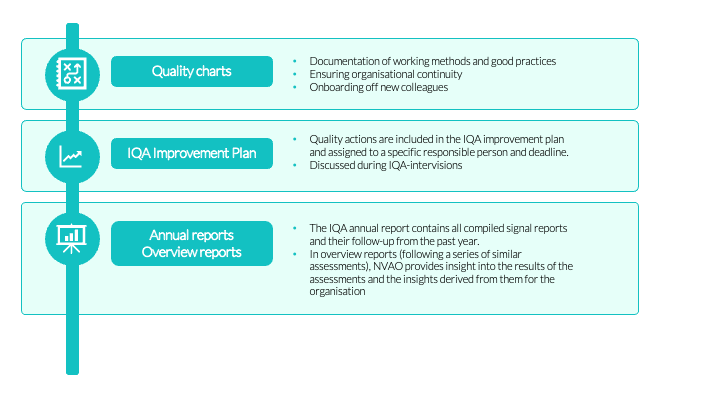
Formal and visible instruments
The visible elements make quality assurance concrete and measurable.
Rituals and culture
Rituals and culture are, by definition, difficult to formalise and must primarily be experienced. Nevertheless, we seek to describe below the ways in which we aim to make our culture tangible:- Celebrating successes to strengthen team spirit and a sense of belonging
- Selection interviews for new colleagues conducted by current staff (ensuring team fit)
- Onboarding and mentorship to transfer values to new employees
- Storytelling by leadership to give meaning to the work and to connect past and future
These less visible practices ensure that formal structures are genuinely embraced and experienced.

Mike Slangen
Want to learn more?
Get in touch with our Coordinator of Internal Quality Assurance!
Mike Slangen - Policy advisor NVAO Flanders & Luxembourg
m.slangen@nvao.org